Saturday, July 24, 2010

St. Ursula and her 11,000 Virgins Sounds Better Than St. Ursula and Her Virgin Named "Eleven Thousand"


Lat. S. Ursula. Ital, Santa Orsola. Fr. Sainte Ursule.
Patroness of young girls, particularly school girls, and of all women who devote themselves especially to the care and education of their own sex.
Attributes in art: Arrow, Virgins, Ship, Crown, Ermine lined cloak, Palm of Martyrdom, Pilgrim’s staff with a white banner and red cross (Christian symbol of Victory), Dove.
Feast Day: Oct 21.


The legend of St. Ursula ranks as the one of the best examples of mistranslation in history. One of the Virgin Patronesses and Martyrs, she is historically one of the most revered saints in the Christian pantheon. She is shown in both historical and devotional pictures with several standard attributes. She always wears a crown because she was a princess. She holds an arrow, as it was the implement of her martyrdom, as well as the martyrs' palm. Often she is shown with a ship, referring to her journey to Rome, or a Dove, referring to the pigeon who indicated her gravesite to St. Cunibert during Mass, which is entirely another story and a big hoo-hah in itself. She wears an ermine lined robe as befits a virgin princess. Pure white ermine lines royal cloaks for a reason which is also pertinent here. Ermine, according to Aelian, upon falling into mud would become stiff and die ,* thus symbolizing the Death before Dishonor credo of Kings and insuring certain extinction for themselves as eventually everyone would want to wear these symbols of innocence and moral purity.** Coincidentally, the ermine is featured on the coat of arms of Brittany, her realm. She sometimes, especially in sculpture, holds her cloak open to let the virgins hiding beneath get a breath of air.***

There is some confusion over the number of virgins with whom Ursula was murdered, however. Tradition holds that there were 11,000, and an extravagant story has evolved to embellish this overcalculation, but in fact, there were probably no more than eleven, maybe only one.


According to Mrs. Anna Jameson in Volume II of her Sacred and Legendary Art, published in 1857:

"The first mention of the definite number of eleven thousand virgins was by Herbert, bishop of Cologne, in 922, and is said to be founded on a mistake of the abbreviation XI. M. V., i.e. eleven martyr virgins, for “undecimilla virginis,” eleven thousand virgins. Others reduce the eleven thousand to one; they say that a virgin named Undecimilla perished with St. Ursula, which gave rise to the mistake.
All these attempts to reduce the legend to a fact leave us, however, in the same predicament: we must accept it in the popular form in which it has been handed down to us, and which, from the multiplicity of representations in Germany and Italy, has assumed a high degree of importance."


So whether we actually accept that there were 11,000 virgins, 11 virgins, one virgin named Eleven Thousand (really!?), or perhaps no virgins at all, for there are those who maintain that St. Ursula never actually existed, we can still enjoy the story of St. Ursula, the spirit of protection she and her crew have provided for women over many centuries, and in particular the rather interesting and almost perverse artwork that her legend has inspired.

Though no one is certain of the date of St. Ursula’s massacre, we do know that it took place in Cologne, Germany and the Huns were responsible, as usual. However, before we get to the martyrdom and the Huns, we have a few chapters of introduction.

Ursula was born a princess of Brittany. Her father was King Theonotus and his mother a Sicilian princess Daria. Both were Christians and they brought up their beautiful daughter in the True Faith. Daria died when Ursula was about 15, leaving the daughter to play the role of hostess at Court. Precociously brilliant and brave, and always gloriously beautiful, she shone at court and her reputation as a rich, sophisticated, knockout brain child spread far and wide.


Across the Channel, over in pagan Britain, there lived a Crown Prince named Conon who was as comely and chivalrous as Ursula was brilliant and beautiful: a match made in heaven (no pun intended).

So Conon proposed (by Royal emissary, of course) and was surprised to learn that Ursula had already made a vow of chastity, dedicating herself to the service of Christ. Not knowing how to answer the proposal in light of this, the King allowed his daughter to address her suitor’s ambassadors personally.

In a speech filed with platitudes and sweetness, Ursula accepted Conon’s proposal with three conditions:

1) Conon shall provide ten virgins of the noblest blood to serve Ursula as her ladies and companions and for each of these a thousand attendant noble virgins, plus an extra thousand for Ursula herself (all the ladies must be or become Christians).
2) Conon shall wait 3 years before marrying Ursula so that she and her 11,000 attendants can make the grand tour of the Holy Shrines and visit the relics of the holy martyrs and saints.
3) Conon must become a Christian and become baptized, as Ursula cannot marry one who does not share her faith. ****

So, much to Ursula’s surprise, Conon agreed! He came to Brittany, met her father, and bid her and her traveling virgins adieu. Some versions of the legend have him staying in Brittany to help rule the kingdom while others have him traveling with Ursula in divine chastity. Either way, she heads out for Cologne, her first stop, where she has a dream that upon her return to that city, she and all her virgins will be massacred and be martyrs for Christ. She told the girls the news and they were thrilled, so they got on with the journey looking forward most especially to the return to Cologne!


They stopped in Basel, Switzerland and some angels helped guide them over the Alps to Rome, their ultimate destination. As fate would have it, Conon missed his betrothed terribly and so set out for Rome by a different route, arriving on the very same day: a happy reunion for all. He met the Pope, changed his name to Etherus to celebrate his new faith, and upon hearing what awaited the virgins upon their return to Cologne, got all hepped up himself that he might share the crown of martyrdom with some very giddy girls. There was a giant pool party where the pope baptized everyone before the ill-omened trip home.


Meanwhile, some wicked pagans who happened to command the Imperial troops in Germany caught wind of all this and thought having that many Christians cavorting through their domains might corrupt and convert too many of their subjects, so they sent a message ahead to the Huns, who happened to be besieging Cologne at the time, that Ursula and her entourage must die.


So the celibate royal couple, the girls (still 11,000, remember), the pope, several bishops and lots of other important personages set out from Rome and upon entering Cologne were set upon by the Huns. Prince Etherus was one of the first to go. Then went the pope, bishops and virgins, egged on by Ursula’s humility and faith. Slashing, beheading and shooting all over the place with the virgins offering little resistance and St. Ursula offering only succor.


The Huns were powerless to touch Ursula, however, because of her charms, so they took her to their leader, Attila, who naturally wanted to make her his bride. Calling him “Son of Satan” or some other pet name, she refused him. So he pulled out his bow and arrow and shot her dead, fulfilling her dream of martyrdom and making quite a mess.****


Since Ursula suffered her martyrdom in Cologne, she is one of the city’s three patron saints, the other two being the We Three Kings of Orient Are, who share one slot, and whose relics are in the Cathedral, and St. Gereon who alone occupies the other and has his own church.
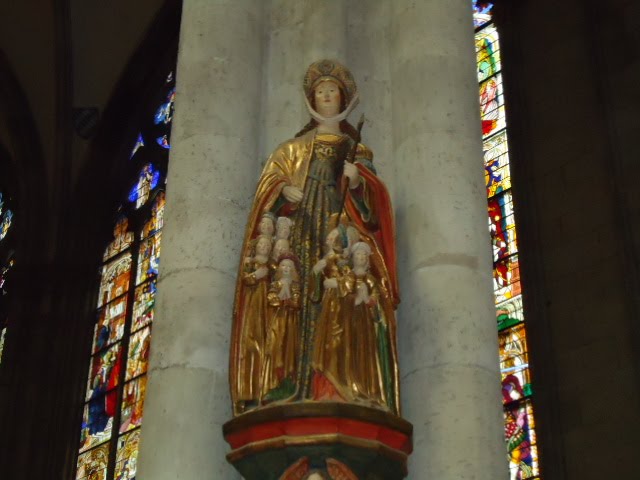

As patron of the city, Ursula is well represented in churches throughout the city, notably in the altarpiece and a nave sculpture in the Dom, as well as the entire cycle of paintings of her legend in the Basilica of St. Ursula, painted over many years by many hands, and featured above. In addition, her basilica contains her tomb and a very special room called the Golden Chamber, (which I have nicknamed the Golden Chamber of Horrors)which houses the remains of the 11,000 virgins, arranged in rococo splendor with many gold reliquary heads and bones spelling out messages to the Virgin Mary on the walls. The relics were discovered in 1106 during an excavation of the city walls. “Divine visions” provided updates to the legend to explain the number of remains and the presence of males among the victims. ("Divine visions.")*****

By the 13th century, her legend had evolved into the fabulous fable we have handed down to us today. Despite her standing as the patron saint of school girls and the city of Cologne, St. Ursula’s feast day was removed from the Catholic Church’s general calendar in 1970 – basically decommissioning her. Below, also from St. Ursula's Basilica is a 17th century (Rubens?) Martyrdom of St. Ursula, a version which captures all the drama of that final bloody moment and hangs just over her tomb. The archer on the right releases the bow as our pallid saint swoons among the dismbodied heads and bloodied corpses of her heaven bound virgins, the rejected pagan smug in his shining armor and eternal damnation.


The tour book from St. Ursula’s Basilica skims over this special room, the parish attendant is none too eager to open it or visitors, few tour guides even mention it, and it is currently undergoing renovation. However, you haven’t seen Cologne until you’ve seen The Golden Chamber of St. Ursula and her 1 to 11,000 virgins, if for no other reason than to ponder:
If there were not, in fact, 11,000 virgins with St. Ursula, then whose bones are these? And if they are not from the 11,000 virgins, are they still saints? What if they are the bones of very bad people? And what if they’re not even virgins? The questions boggle the mind: one of Catholicism’s most bizarre legends and one of the most macabre rooms in all of Christendom.


* Guy de Tervarent: Attributs et symboles dans l'art profane, 1450-1600, Geneva, 1959
** Jean Chevalier and Alain Gheerbrant: A Dictionary of Symbols, Penguin Books, 1996
*** James Hall, Dictionary of Subjects and Symbols in Art, New York, 1979
****Mrs. Anna Jameson: Sacred and Legendary Art, Vol II, Houghton Mifflin, 1857
*****St. Ursula Cologne Schnell Art Guide #2749, First English Edition, 2010

Monday, July 19, 2010

Surprise! Cache of Caillebottes Found in Cologne!


In my June 7 post, I wrote about Gustave Caillebotte, which was basically an opportunity for me to rant about one of my favorites. Then during a recent trip to the Wallraf-Richardz Museum in Cologne, Germany, I was excited to see no less than nine Caillebotte paintings, more than I have seen in any single collection, except the Musee D’Orsay or a retrospective exhibition, such as the one held by the Brooklyn Museum last year.


In fact, a couple of these may have been included in that show, particularly Drying Clothes at the Seine, (1892) which is a symphony of diagonal, slashing brushwork and Sailing Boat at the Seine near Argenteuil (1893), but as my copy of the exhibition catalogue is languishing in my sister’s garage since my move to Europe I can’t confirm my memory.


Classically Caillebotte are the forced receding angles and sharp geometry of the fields in The Plain of Gennevilliers, Yellow Fields, (1884) and Hills Near Columbes (1884), and even in the kooky little Boats and Shed on the Banks of the Seine (1891) with its shed about to slip into the river.


The way the river and fields recede away from the viewer in these paintings is Caillebotte resolving some of the same spatial issues he mastered in his larger, earlier landscapes like Rainy Day – Paris, at The Art Institute of Chicago®, and Le Pont de l’Europe at the Petit Palais in Geneva (both featured in my previous post).


But right up there is the little canvas, Garden in Trouville (1882): such a jumble of color and lively brushwork that the painter has almost left the realm of impressionism, heading dangerously close to abstracting the summer garden - paving the way for artists of the next generation to do just that.


These paintings are not included in the Caillebotte.org online collection (though it claims to be comprehensive) and are not in the online images on the museum’s website, so I thought I’d give my fellow Caillebotte fans a little something special by posting these myself, and if you're in Cologne, don't miss them. Enjoy!

Tuesday, July 13, 2010

The Baker of Eeklo at Muiderslot Castle

So I struck out from Amsterdam the other day on my bike to Muiderslot Castle, about a 45 minute bike ride to the east. Little did I know what entertaining artworks I would encounter.
First of all, Muiderslot is a lovely little miniature castle, a true medieval relic complete with interesting history and all. Designed by a Count Floris V in the 1200’s, the castle numbers among its residents the very famous 17th century poet, P. C. Hooft. It has parapets, a moat, a drawbridge and all the requisite castle stuff: some grand rooms and armaments, staircases and boiling oil. Of course now it is surrounded by a harbor and industry, so it seems s little less intimidating, remote and feudal than it once did, I’m sure. Now it’s just quaint and adorable, set amid its gardens overlooking the zee.


Inside the grand rooms are the still lifes, portraits and landscapes you would expect to find in a restored castle which is open to the public, but there is one painting which came as a total surprise and delight to me. From the late 1500’s, by Cornelius van Dalem and Jan van Wechelen (neither of whom I had ever heard of either), the painting is entitled “The Baker of Eeklo” and illustrates the regrettably obscure legend of said baker.

It seems that if your head is acting badly, looks poorly, or for whatever reason you are not pleased with it, you can visit the Baker of Eeklo and he will guide you through the process of re-baking your head! It’s all there in the painting, just look, mon petit chou!

They remove the offending head, replace it temporarily with a cabbage (yes, a cabbage), re-knead and re-shape the head, apply a new finish, coat with egg yolk for luster, just like a hot cross bun, pop it in the oven and Voila! New head! There are a few possible side effects with the process, however, so before you decide to try it, be aware that your head could potentially come out half-baked, leaving you, well, half-baked, or if your head were left in too long, you could become a hothead, and if it fell like a soufflé, you could be a misfire! Moral: Be happy with the head you have, it could come out worse next time.

As you see, contrary to modern hygienic standards, all of the Baker’s Assistants work shirtless, probably because of the heat of the oven, but perhaps also because theirs is messy work. On the far right of the canvas, there is a woman turning away as one of the Assistants (carefully) chops off her husband’s head. Just before them is a basket of cabbages from which the Assistant will choose a temporary replacement for the gentleman’s head while it undergoes the re-baking process. Notice the husband’s and all the Cabbage-heads’ hands are clasped in prayer…for success, I guess.

In the center foreground, you see three people whose heads are being baked waiting patiently, cabbages substituting for their heads, and a basket of three heads ready to be re-attached. On the far left of the canvas, there is another Assistant reattaching the head to the man whose cabbage lies at his own feet. Apparently, that Assistant is working left to right and will reattach the three heads in the basket to the three Cabbage-heads in the waiting area.

In the background are two other scenes which complete the story. On the left you see three Assistants working feverishly by the fire: one is kneading a head, one painting on a new finish, and the third placing a head in the oven on a long spatula as if it were a pizza.

On the right is my favorite detail. The Baker himself is standing almost in the center of the canvas in a bright red robe speaking with a woman in a black cape who is bringing in a disembodied head. My theory is that it’s her husband’s head and that she (or he) is displeased with the Baker’s results and is returning the defective merchandise. Likewise is a man in a black cape with red leggings hiding a head under his cloak, presumably another return - hothead, half-baked or freak. The baker makes no guarantees.

The perspective is a little woobly, as you might expect from a painting from the late 1500’s, the faces are a little lifeless, the clothes a little stiff and the cabbages a little idealized, but there is a naïveté and charm to it that makes it absolutely delightful and well worth the trip to Muiderslot.
If you are lucky enough to ride a bike from Amsterdam to Muidersport you will pass another wonderful gallery, this one in the great outdoors. Under the A-1 highway, as it crosses the Amsterdam-Rijn Kanal, you cannot miss the great graffiti on the bridge supports. As they are more self explanatory than the legend of the Baker of Eeklo, I will leave you to ponder the images. I’m sure I will share more of the local graffiti another time. Tot Ziens!


Sunday, June 20, 2010

Bouguereau - Another Great Artist of Which You've Probably Never Heard


In my last post, I wrote about Gustave Caillebotte and his support for and practice of the “New Art,” Impressionism. Unpopular in the 19th Century, only visionary art collectors would touch the Impressionists. Academic style painting, which strove for photographic realism and smooth finishes yet featured idealized scenes, characters and compositions, was still in vogue. Only in the early twentieth century did the public and art critics accept the Impressionists/Post-Impressionists and other related movements as serious and worthy. Once they did, however, they expunged their collections of all the late Academic painters. Being the last of the great Academic painters, Adolph William Bouguereau’s work was banished and forgotten very soon after his death in 1905. Now his paintings are becoming very valuable as critics reconsider some of the late 19th century artists whose work was passed aside for too long in favor of the Impressionists. There was more going on artistically in France in the late 19th century than just Impressionism, and some of what has been overshadowed by that movement is worthy of another look.

Somewhat more appreciated by today’s art enthusiasts, Bouguereau was accomplished and successful his day. He was Grand Officer of the Legion d'Honneur, President of the Societe des Artistes Francais, member of the Academie des Beaux-Arts and winner of the Prix de Rome. Unfortunately for his reputation and value to art history, he happened into the world at the same time as Degas, Monet, Manet, Toulouse-Lautrec, Gaugin, Van Gogh, Whistler and Sargent. The Impressionists largely respected him as a painter but derided him as an old fuddy duddy. Once their work became popular, he was completely forgotten.


Early twentieth century dealers needed art which was produced quickly in order to keep up with the demand of the new upper classes created by the Industrial Revolution. They suppressed the time consuming, old style Academic painting in favor of new, quickly produced, less “finished” works. Being the epitome of “finished,” Bouguereaus were relegated to attics, closets, and storerooms. Bouguereau was a prolific painter who produced an impressive oeuvre of almost about 800 paintings. Matisse, a generation later, was able to produce thousands because of his faster technique and less precise rendering. Matisse was once Bouguereau’s student. Bouguereau famously told Matisse to learn to draw perspective, and that he would never amount to anything as an artist. If the standards to which Bouguereau held himself had still been valid, Matisse would never have been successful or important. But Matisse was of the generation which changed the standards, and that’s what made him important. In the long run, he won.


Bouguereau is where the old Art broke with the New. He was the last of the great French Academic Painters in the line of Chardin, Poussin, Fragonard, David, and Ingres. He lived in the society which produced Impressionism and Art Nouveau, but by the time the latter came around, he was an old man, saddened by the loss of his family, and unable and unwilling to adapt to the New Art. He was a trained academic painter, that’s who he was and that’s what he did.


Known now mostly for his skillfully executed but sort of sickening, saccharine-sweet innocent country girls, often with oversized, pleading eyes and the innocence lost symbol of a broken vase or eggshell somewhere in the composition, Bouguereau is one of my personal favorites not because of these idealized gamines, but because of his mythological scenes, floating women and angels. It’s always fun to spot a Bouguereau in a gallery. It’s either one of those “lost innocence” things that will make you roll your eyes, but appreciate how well the skin, fabrics and background elements are rendered, or one of the large mythological canvases or floating women which simply take your breath away.

Early in his career, he did the mythological scenes to get notice and commissions at the annual Salon held by the French Academy, the official channel for art in France at the time. But the time for mythological scenes was gone. His “Nymphs with Satyr” at the Sterling and Francine Clark Art Institute (which hung for many years over a bar!), and “Orestes Pursued by the Furies” in The Chrysler Museum at Norfolk, VA are both huge canvases and prime examples of these early efforts at large scale mythological scenes.

“Nymphs with Satyr” shows several nymphs nude, as nymphs would be, teasing an old satyr who looks exactly as you imagine a satyr to look. Bouguereau has resolved all the design issues which made previous attempts to render satyrs seem awkward by comparison. The tender, white skin of the nymphs, the hard leather of the old satyr’s ear, the trees, the rocks, the crowd of baccantes in the background are all perfectly rendered, but prettier than in real life.


“Orestes” is one of my favorite paintings, because it is the first painting I fell in love with as a child studying Greek Mythology, and because I still find it superbly painted and striking in every way. It is at once violent and resolved, chaotic and restrained - poetic even. The Furies are chasing Orestes, holding the body of his mother, Clytemnestra whom he has just murdered. Wait: it gets better. He killed his Mother in retalliation for killing her husband, Orestes’s father, Agamemnon. Soon, Athena - Goddess of Wisdom and War - will appear and tell the Furies to back off, that Orestes’s crime of Matricide was in retribution for her prior crime of Regicide (not to mention Spouse-icide, if there's such a word, and if not why not??) in the killing of Agamemnon, but Bouguereau has chosen the moment of most terror, wrapping the horrible instant in a heart shaped composition, balanced on Orestes’s feet and before a vague, dark background, with the Furies and Clytemnestra floating in air.

The passage where all the hands are pointing at Orestes, Clytemnestra’s dead hands falling from the knife still in her breast, and his blocking his ears in terror from their horrible and incessant screeching, is magnificent! Bouguereau was a master at rendering skin and the tones of the characters in this scene are both varied and real. Orestes is bronze from the sun while the Furies, in varying sickly shades of mauve point to the freshly dead Clytemnestra, herself of a realistic pallor. The whole, nearly monochromatic composition is enlivened by the deep red drape of Clytemnestra’s robe and the blue swirl of fabric over the Fury’s leg in the foreground.

Tending to the melodramatic, Bouguereau’s mythological scenes were considered too graphic, sexual and violent in their time, so he opted for gentler scenes of the country girls, but when he suffered the personal tragedy of the loss of his wife and children, he began to paint scenes of angels in addition to the gamines and nudes. For the most part, he painted what he wanted and patrons waited long periods to receive the paintings they purchased.

Worth notice are the angel paintings. One is The Virgin with Angels at the Museum at Forest Lawn Memorial-Park in Glendale, CA. Angels have long befuddled artists, as it is difficult to paint with confidence what you have never seen. Even the great Titian’s and Rubens’s angels seem a little awkward, like humans with wings glued on. Bouguereau’s on the other hand are actual angels, ivory white, perfect, ethereal, poised, powerful, loving and actually able to fly.

Bouguereau was often accused of being a letch and preferring to paint naked women. In fact, he painted what he liked and what sold. He liked nudes and they were popular. He has the reputation as being the first artist to paint female nudes not as heroic or mythological, as Caillebotte was the first to paint non-heroic nude men, but I don’t know about that. He seems to be the first who really enjoyed it and did it a lot, I’ll give you that.

Later in his career, he painted a series of ethereal women floating in windswept landscapes. One such is "Evening," which Marjorie Merriweather Post acquired to display in the men's toilet in her home, now Hillwood Estate, Museum and Gardens in Washington, DC! These were painted at the same time that Art Nouveau was gaining popularity throughout Europe. Dreamy depictions of women were all the rage. Twining trees and tendrils, idealized women’s faces and gossamer garments were in fashion and Bouguereau created images both in keeping with his time, and yet still connected to the academic, nearly photographic style of painting required by the French Academy. His depictions of dreamlike ladies were nearly pornographic to some contemporary viewers and, though one can see a similarity with Art Nouveau in the subject and idea, his treatment is thoroughly academic. The women are not stylized, in fact they are idealized. They are not masks or imitations of women like so many of the images in Art Nouveau, but fantasy women in fantasy poses: floating, dreamlike and big as life.
William Adolph Bouguereau’s paintings are the epitome of what the French Academy stood for: idealized, grand images of mythological or religious stories or simple genre scenes rendered with subtle brushwork, a smooth finish and elegant compositions. After his work earned him a high degree of acclaim and fortune, Bouguereau enjoyed the luxury of being able to paint what he wanted. Some of his works are among the best yet least well known of the 19th century: his brilliance an apt period at the end of the metaphorical sentence which began with the Renaissance and ended with Impressionism.


Monday, June 7, 2010

Caillebotte

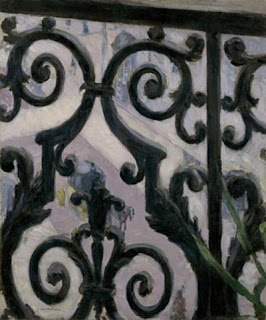
I felt guilty when I visited the Van Gogh Museum in Amsterdam that one of my favorite paintings in the collection is not by Vincent Van Gogh. Having wrestled with the guilt, I am now over it and can aver that Gustave Caillebotte’s View from a Balcony is one of that collection’s highlights for me.


Long a Caillebotte fan, I consider him the lost Impressionist. He was a temperamental character who was more influential in the development of both modern art and racing yacht designs than many people - even art or yachting aficionados - realize. Because Caillebotte was the son of a wealthy Bourgeois in mid 19th Century France, he did not work for a living, yet he lived in luxury, unlike most of the more famous Impressionists. He painted because he wanted to: a gentleman’s pursuit. He also collected art and upon his death left the nation of France a legacy which a century later became the nucleus of Paris’s Musee D’Orsay.

As my hero Kirk Varnedoe, legendary art historian and Chief Curator of Painting and Sculpture at The Museum of Modern Art in New York wrote in his essay Odd Man In: A BRIEF HISTORIO-GRAPHY OF CAILLEBOTTE'S CHANGING ROLES IN THE HISTORY OF ART:

Despite the rhetoric of its early advocates, the success of Impressionism did not arrive by destiny. It required, beyond the achievements on the canvases and the serendipity of circumstance, hard work on the part of several individuals among whom Gustave Caillebotte was one of the most dedicated. He haggled and negotiated to keep the group together through periods of fractious disagreement; and when he had to, he rented the exhibition space, paid for the advertising, bought frames, and hung the pictures. In what would now be called the management and marketing aspects of Impressionism, he was an indispensable asset.

One of the founders and funders of the Impressionist movement, Caillebotte’s role in the development of Modernism was pivotal, perhaps less for his painting than his tireless advocacy and collecting. He paid Monet’s and Renoir’s studio rents. He bought paintings by the scores, for which he would pay the artist inflated prices. He would pay more than the paintings were worth – more than the artists were asking for them - so that they could go to the next patron and say “my last painting fetched THIS much…,” and increase the price of their work. He was in on the selection, and arrangement, and all other details of the Impressionists’ Salons, even exhibiting his own work to some critical success.


His best known paintings certainly are Rainy Day – Paris, at The Art Institute of Chicago®, The Floor Scrapers at the Musee d’Orsay in Paris and Le Pont de l’Europe at the Petit Palais in Geneva.


He also has the Fruit Displayed on a Stand at Boston’s Museum of Fine Arts, and a famously foreshortened Luncheon in a private collection. His paintings are being sought and acquired by museums and collectors worldwide since his “rediscovery” in the 1950’s, when his heirs’ descendants began selling the paintings they had inherited. Kept in storage for nearly a hundred years, Caillebotte’s canvases, reputation, talent and efforts were largely forgotten.

The collection he amassed, much of which he left to France, stayed either in private hands or museum vaults until a couple of Impressionist exhibitions and the opening of the Musee d’Orsay in the 1970’s reintroduced his collection and his work to the world. His Renoirs, Degas, and Monets form the basis of the Orsay, perhaps the most impressive collection of Impressionist art in the world, and to him we owe thanks for his vision of a “new art,” which over a hundred years in the forming, forgot him along the way.

Gustave Caillebotte made other contributions as well. Many scholars consider his painting style too academic or realistic for him to be an Impressionist, but his subject matter and approach to perspective were radically new, and very much in the Impressionist spirit. The seemingly haphazard arrangement of colors and white in the Fruit Displayed on the Stand at the MFA, the severely exaggerated angles and clearly impressionistic rendering of the puddles and rain in Rainy Day – Paris, the overbearing foreshortening of the dining table in Luncheon mark Caillebotte’s work as radical for its time.

His paintings of butcher shop windows with calves' tongues and dead birds were shocking. His Floor Scrapers were to working class men what Degas’ Laundresses and Dancers were to working class women: treated by the Impressionists, these are a new take on the peasant/servant scenes so popular generations before in Dutch and Flemish art, and so romanticized by earlier generations of French artists. These are men in the act of hard labor. They are not rollicking peasants or scrubbed-clean shepherds. They are shirtless, sweaty and filthy. Though recognized for his skill, his choice of subject was deemed unsuitable by the reviewers of the Salon where the painting was first shown.

His later boat scenes and garden views may fade into the Impressionist morass, but his male nudes set him apart as the first artist to have painted nude male figures which were not heroic, historical or biblical (here: Man at his Bath from London’s National Gallery), or as I like to call this series Bob at the Bath. Now, partly due to his own perseverance in putting together the first major collection of Impressionist art and insuring that it stay together until public taste demanded it be taken seriously and placed in its own museum, Caillebotte has come full circle; his collection is appreciated by the world and his work is becoming known.

Aside from painting, Caillebotte also had passions for gardening and for yacht racing. His gardens and yachts appear in many of his later paintings. His boat designs radically changed the profile of the racing yacht and resulted in the sleek racing yachts of today, vastly more streamlined and faster than before he became a record-setting captain in boats of his own design. But in his early years, painting was his primary passion.

View from a Balcony at the Van Gogh Museum is classic Caillebotte. It has a lot of what I would look for in a Caillebotte. It’s a very high angle view, a typical vantage for this artist who consistently chose “different” angles than other artists. We are looking through the railing of his apartment on the Boulevard Hausmann in Paris, brand new, imposing and expensive. Caillebotte painted several views of this balcony, some looking down and some with men standing on it admiring the view, and begging questions of the viewer.


Caillebotte was obsessed with what we would now call modernity and this balcony was the height of modern in its day, overlooking the newly rebuilt and completely “modernized” Paris. I posit that Caillebotte was in a way trapped on this balcony.

Though he had a mistress, or female companion, for several years, he never married: an unusual feat for a wealthy man in Paris of the 1880’s. He painted several canvases of men leaning on this balcony, the male Bathers, the series of Floor Scrapers, the male House Painters and mostly men in his street and boating scenes, leading some to speculate that in today’s parlance, Caillebotte might have been “gay” or “bisexual.” Though those labels did not exist as such in the 1880s, and the social identities of gay and bisexual persons did not exist as they do today, certainly homosexual behavior and attractions did, and perhaps he was. His paintings of men are often as tender as and his nude men as erotic as some of Renoir’s women.


In View from a Balcony, there is a carriage in the center of the canvas heading down the diagonal stripe of the Boulevard. There’s a round poster kiosk in the background and a lone pedestrian at the very bottom of the scene. But what dominates the composition and what makes it classically Caillebotte, is the iron railing.

Here he is giving us with this railing what he gave us with the fruit stand, and the butcher window: a shocking new perspective on a scene we might see every day, and which popular taste of the day would not consider worthy of being recorded in oil on canvas. He has filled the canvas with the iron railing and the street scene below is in a hazy, misty, mauvy background, so that there is an almost solid barrier between the viewer and the city below. The street scene is a little blurry and in a very pale palette, but the railing is black, heavy and wrought iron. It dominates the canvas, creating a daring take on the classic landscape or street scene.

With the number of paintings of men which Caillebotte painted on this balcony, one may wonder if there is some psychological statement here of entrapment. If he were gay, as some of his subject matter might suggest, was he acknowledging that he lived behind a barrier, perhaps the barrier of public acceptance of his supposed attractions or relationships? Whether or not he was gay, he has created a claustrophobic scene out of a landscape, a format which is usually so open. He has created a cage out of a window. One must wonder.

Admittedly, Caillebotte’s View from a Balcony is not the best painting in the world, nor is it the most complex, largest or most valuable. It is however, exactly what the Impressionsists hoped to create: art with a new perspective. Here that new perspective is trapped, tight and claustrophobic, perhaps a parallel for life in Paris at the time. In a painting with very few scenic elements, Gustave Caillebotte has managed to create a work which both pushed the boundaries of what was acceptable in art in his day, and begs questions of its viewer in ours. As Kirk Varnedoe concludes:

...it is unavoidable, even if awkward and ultimately less than informative, to broach the general question as to whether Caillebotte was "as good as" the other Impressionist painters. Without belaboring the obvious caveats about relative criteria of "good," a short and simplified answer would have to be "no." He had neither Edgar Degas's skills as a draftsman nor Monet's as a colorist, and his development was not as extensive as those of his fellows. Yet comparing picture for picture - and speaking both as a historian of modern art and on more purely subjective aesthetic grounds I would value any one of Caillebotte's best works (e.g., "Floor Scrapers," "Young Man at His Window," "Boulevard Seen from Above," and especially the monumental "Pont de l'Europe" and "Paris Street: Rainy Day" as a more important, original, and rewarding painting than any Pissarro, all but a handful of Renoirs, and a fair number of Monets from the same period. In these particular pictures, and with all the familiar qualifications that should surround such a judgment, Caillebotte's achievement as an artist is at least as complex and enduringly interesting as that of his peers. This cannot be anything other than a personal assessment, but I suspect that I am far from alone in making it.

And indeed, Mr. Varnedoe, you are not. I would add that Caillebotte’s best canvases are “more rewarding than” any Pissarros, Renoirs or Monets “of the same period.” His perspective is just that different and truly modern.


Gustave Caillebotte - The complete works by Gustave Caillebotte User comments, slideshow, eCards, biography, more than 200 images of paintings and more!