Showing posts with label Dutch art. Show all posts

Tuesday, July 13, 2010

The Baker of Eeklo at Muiderslot Castle

So I struck out from Amsterdam the other day on my bike to Muiderslot Castle, about a 45 minute bike ride to the east. Little did I know what entertaining artworks I would encounter.
First of all, Muiderslot is a lovely little miniature castle, a true medieval relic complete with interesting history and all. Designed by a Count Floris V in the 1200’s, the castle numbers among its residents the very famous 17th century poet, P. C. Hooft. It has parapets, a moat, a drawbridge and all the requisite castle stuff: some grand rooms and armaments, staircases and boiling oil. Of course now it is surrounded by a harbor and industry, so it seems s little less intimidating, remote and feudal than it once did, I’m sure. Now it’s just quaint and adorable, set amid its gardens overlooking the zee.


Inside the grand rooms are the still lifes, portraits and landscapes you would expect to find in a restored castle which is open to the public, but there is one painting which came as a total surprise and delight to me. From the late 1500’s, by Cornelius van Dalem and Jan van Wechelen (neither of whom I had ever heard of either), the painting is entitled “The Baker of Eeklo” and illustrates the regrettably obscure legend of said baker.

It seems that if your head is acting badly, looks poorly, or for whatever reason you are not pleased with it, you can visit the Baker of Eeklo and he will guide you through the process of re-baking your head! It’s all there in the painting, just look, mon petit chou!

They remove the offending head, replace it temporarily with a cabbage (yes, a cabbage), re-knead and re-shape the head, apply a new finish, coat with egg yolk for luster, just like a hot cross bun, pop it in the oven and Voila! New head! There are a few possible side effects with the process, however, so before you decide to try it, be aware that your head could potentially come out half-baked, leaving you, well, half-baked, or if your head were left in too long, you could become a hothead, and if it fell like a soufflé, you could be a misfire! Moral: Be happy with the head you have, it could come out worse next time.

As you see, contrary to modern hygienic standards, all of the Baker’s Assistants work shirtless, probably because of the heat of the oven, but perhaps also because theirs is messy work. On the far right of the canvas, there is a woman turning away as one of the Assistants (carefully) chops off her husband’s head. Just before them is a basket of cabbages from which the Assistant will choose a temporary replacement for the gentleman’s head while it undergoes the re-baking process. Notice the husband’s and all the Cabbage-heads’ hands are clasped in prayer…for success, I guess.

In the center foreground, you see three people whose heads are being baked waiting patiently, cabbages substituting for their heads, and a basket of three heads ready to be re-attached. On the far left of the canvas, there is another Assistant reattaching the head to the man whose cabbage lies at his own feet. Apparently, that Assistant is working left to right and will reattach the three heads in the basket to the three Cabbage-heads in the waiting area.

In the background are two other scenes which complete the story. On the left you see three Assistants working feverishly by the fire: one is kneading a head, one painting on a new finish, and the third placing a head in the oven on a long spatula as if it were a pizza.

On the right is my favorite detail. The Baker himself is standing almost in the center of the canvas in a bright red robe speaking with a woman in a black cape who is bringing in a disembodied head. My theory is that it’s her husband’s head and that she (or he) is displeased with the Baker’s results and is returning the defective merchandise. Likewise is a man in a black cape with red leggings hiding a head under his cloak, presumably another return - hothead, half-baked or freak. The baker makes no guarantees.

The perspective is a little woobly, as you might expect from a painting from the late 1500’s, the faces are a little lifeless, the clothes a little stiff and the cabbages a little idealized, but there is a naïveté and charm to it that makes it absolutely delightful and well worth the trip to Muiderslot.
If you are lucky enough to ride a bike from Amsterdam to Muidersport you will pass another wonderful gallery, this one in the great outdoors. Under the A-1 highway, as it crosses the Amsterdam-Rijn Kanal, you cannot miss the great graffiti on the bridge supports. As they are more self explanatory than the legend of the Baker of Eeklo, I will leave you to ponder the images. I’m sure I will share more of the local graffiti another time. Tot Ziens!


Friday, May 28, 2010

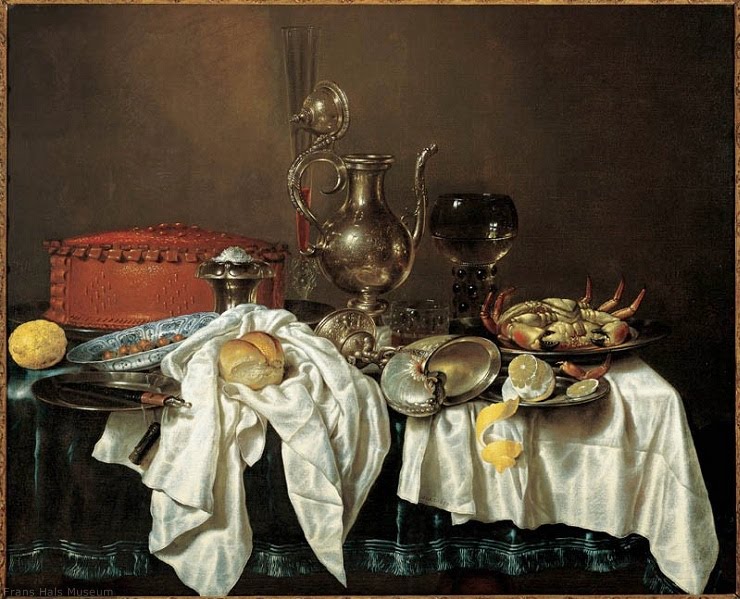
Dutch Still Life - Willem Heda's "Still Life with Pastry and Silver Pitcher" at the Frans Hals Museum, Haarlem, The Netherlands

I love the 17th Century Dutch Still Lifes. Scholars still argue what they are about, but coming as they did out of the post-Reformation Netherlands, my vote goes to the more religious interpretation; I think they are more than simply pretty pictures of expensive things.

Since the Reformation in Holland banned religious painting as idolatry, paintings of overtly religious scenes changed from devotional images to historical ones, and the pious found new ways to express their religious convictions through the art they commissioned. There were still religious paintings: in fact, at the same time as these paintings were popular, Rembrandt and other Dutch artists painted many religious themes. However, they were not intended as objects of devotion as previously, but as historical ones, telling stories from the Bible which were applicable moral lessons in the 17th Century. These Still Life paintings could just be pretty pictures of fancy, hard to paint objects, as some assert, but I agree with those who interpret them as religious messages.

Beginning rather humbly as a genre in the early 1600s, the view of the tabletop was originally from a decidedly high viewpoint: standing, looking down on the scene. The objects featured were everyday objects arranged as a group, usually with a dark background and the front edge of the table showing.

As the century progressed and the Still Life genre became more popular, the images also became more complex, both in the number and variety of objects, and in the inclusion of the corner of the table. This was also the era of the “gentleman collector,” who amassed rare objects and expensive, fragile serving pieces from around the world. These paintings reflected the growing interest in “curiosity cabinets” and collections of exotic and expensive items among the Dutch upper and middle classes.

And yet there is more to these paintings than than a display of fine and rare objects. There is more to them than bravura painting techniques, a wealth of texture and color, glass, liquids and metals painted in nearly photo-realistic style. The condition and placement of the objects in relation to the tabletop and the viewer would also have communicated a religious message to the contemporary viewer. In these 17th Century Still Lifes, references to long life and “getting right with God” abound. They would have been recognized instantly in the 17th Century, but the symbols are all but lost on a modern viewer.

To examine some of the iconography of the 17th Century Dutch still life, I am going to look at Willem Heda’s (1594-1680) Still Life with Pastry and a Silver Pitcher, at the Frans Hals Museum in Haarlem, Netherlands. Painted in 1658, it is a late and splendid example of the tabletop still life.


We are looking at the table from barely above the level of its surface. We are looking almost across the top of the sumptuous pastry which dominates the left side of the canvas. This low perspective pushes all the objects together so that they visually overlap, block and interact with one another, and we see very little of the table’s surface. Some of the objects reflect other objects. In the pitcher, for example, we can clearly see the reflection of the crab, the wineglass, the overturned Nautilus cup, and the multi-paned window which illuminates the scene. In the silver plate on the left, we can see the reflection of the very costly blue patterned Chinese-import plate leaning above it.

The painting presents a strong horizon line directly through its center. Along this central band is some very fine textural representation. The gigantic, perfect pastry on the far left, the crust of the bread, the peel and fruit of the lemon, the iridescence of the Nautilus shell, the fine weave of the linen napkins, the gleam of the leather knife sheath, and a myriad other details create an interplay of color and texture which pulls us right into the painting, as we find ourselves examining the veracity of the smallest details and interpreting them as metaphors for the rich textures of our lives.

My favorite detail is the fine Venetian glass flute in the center background. Filled with a bright red liquid, it may refer to the blood of Christ, if you agree with to the religious interpretation of the Still Life. If you do go with this interpretation, then the unbroken bread in the foreground and the wine in the Venetian glass would be clear references to the Last Supper. If you don’t agree with the religious interpretation of the painting, then you still must admit the objects are rendered masterfully.

The contemporary viewer would have been as impressed with the quality of the rendering as we are today, but would have been instantly aware of the Vanitas, “We’re all going to die,” “Get right with God” theme represented. Indeed, I think the religious interpretation is the real text and subject of the entire genre.

In this painting, as in so many others, the plates are hanging precariously over the edge of the table – the one on the left seems to stay on the table only of its own volition! These plates could fall off the table at any time, which the contemporary viewer would have understood as a reference to the uncertainty of life.
The long, unbroken peel of the lemon on the right expresses the wish for a long, unbroken life for the person who commissioned this painting. The wineglass is not empty, but it is not full either: the implication being you don’t have too much time to get right with God. The coruscating Nautilus shell cup, lying on its side is clearly empty and not fulfilling any task, reminding us that we are to be useful as well as valuable in this life, because it is short. The knife, sheathed but uncapped, is unusable at this time unless removed from its sheath, but is still balanced precariously over the edge of the table.

Think about the crab for a moment. Some might consider the inverted crustacean to be a jarring and inappropriate juxtaposition with the other elements of the composition. An expensive and rare delicacy, it would only be served on the table of a wealthy person, however, dead and inert, and with one leg removed and placed on the plate in front, it is at the same time an expensive delicacy rendered photograhically and another reference to the Vanitas theme. The contemporary viewer would have been as wise as we are to how unpleasant this item will be in just a day or two. “Get right with God, the time is short before you start smelling too, no matter how expensive or rare you might be” is the message here.

In many of the paintings of this genre, we see the edge of the table, which often has a chip or knick in it, referring to the impermanence of life. Often a candle burned low and extinguished sits among the valuable items, the extinguished flame an obvious reference to the ephemeral nature of life. In this painting, the top of the wine carafe is open and the contents are evaporating. Even that large, beautiful pastry (meat pie?) on the left won’t be so pretty, nor smell so heavenly after a few days, so eat up!

Life is uncertain. It is a banquet to be savored and lived fully. We are to be useful and productive. We are to shine and reflect the beauty of those around us. The presence of the salt reminds us that we are the “salt of the earth.” These are the messages hidden in these beautifully chosen and artfully arranged objects. They may not be the sweeping, baroque, Counter-Reformation Saints and Madonnas of Ruebens and Van Dyke, Heda’s contemporaries in neighboring Catholic Flanders, nor his fellow countryman Rembrandt’s starkly lit biblical scenes, but they convey a religious theme nonetheless, and unlike some of the objects depicted in them, Dutch Still Life paintings will be around for us to quibble over for a long, long time.