
Day 2 -
We will start Day 2 at the Pantheon around, say 8 am. I trust the reader will easily find such an august landmark and will want to linger in the shade of the Piazza and drink capuccino all day, but I encourage a sip from one of the fountains instead. Hold your finger over the flow of the water, and it will be diverted into a convenient arc for sipping. Designed that way thousands of years ago to keep the Roman population hydrated with the fresh water from the Roman aqueducts, and still in use today! OK, do all that, and when you're done, turn your back on the Pantheon and walk along the left side of the piazza to its end, where you will turn left on a little pedestrian street, the Via Guistiniani.
We will start Day 2 at the Pantheon around, say 8 am. I trust the reader will easily find such an august landmark and will want to linger in the shade of the Piazza and drink capuccino all day, but I encourage a sip from one of the fountains instead. Hold your finger over the flow of the water, and it will be diverted into a convenient arc for sipping. Designed that way thousands of years ago to keep the
Roman population hydrated with the fresh water from the Roman aqueducts, and still in use today! OK, do all that, and when you're done, turn your back on the Pantheon and walk along the left side of the piazza to its end, where you will turn left on a little pedestrian street, the Via Guistiniani. Walk one block and the first stop of the day is ahead on the right corner: the Chiesa de San Luigi dei Francesi, the church built by the French kings in Rome. It was built to dazzle the visitor, and it does, as only the many Louis could.

Inside, notice all the Fleurs de Lis everywhere, the symbol of the House of Bourbon. There are so many flourishes and tombs in here, you could spend quite some time. Go ahead, today is more at your own pace than yesterday.
We have come here to see the Chapel of St. Matthew. You won't be able to miss the crowds around it, in the front left corner of the church. With three Caravaggio paintings overwhelming a very small chapel, they are a wonderful argument for leaving works of art in situ: the viewing conditions in modern museums and galleries cannot approximate the viewing experience of seeing the work in the environment for which it was designed. Even with the crowds, it is possible to lean against the side wall or a column and soak in these three amazing paintings.
 Over the altar is the Inspriation of St. Matthew. He jumps up from his desk as an Angel appears. The diagonal slash of his body, the perfect arc of the Angel floating above the startled Saint are isolated in a field of black. Notice the foot of the stool on which St. Matthew rests his leg; it is hanging off the ledge in the foreground, moved suddenly as Matthew jumps up and practically falling onto the altar table, just as the corner of the desk and the edge of the book jut forward from the picture plane. The mostly vertical folds in his robes give the painting a strong vertical axis leading the eye directly to the Angel, and there is a remarkable bit of negative space between the head and shoulder of St Matthew and the heavenly visitor.

On the left wall of the chapel is the scene of The Calling of Matthew, my personal favorite of the three. The light appearing from the right side of the canvas acts on the viewer like looking into bright light in real life; it almost blinds the viewer to the scene in the shadows directly below the wedge of light and window on the right side of the canvas. There, in the shadows of the holy light which falls on a startled Matthew, sitting counting his revenue with his colleagues, is a barely discernable Jesus with the merest hint of a halo, reaching his hand out in exactly the gesture as Adam on Michelangelo's Sistine Chapel ceiling. With Jesus, and echoing his gesture is St. Peter, clad as he always is in blue and yellow. Caravaggio uses all his tricks to draw the viewer into this painting: the mystery of the shadows, encouraging us to fill in those dark places with our imagination, the open place at the table, inviting us to join the group on the left, the moment of obvious communication between Matthew and Jesus, with the two boys' brightly illuminated faces completing an illuminated line between the two principal figures. Like the Conversion of Paul at Santa Maria del Popolo, included in Day 1's itinerary, the light is that of the Holy Spirit, calling the Apostle to his destiny. Here we also see Jesus and Peter in the robes of bibilcal times, whereas Matthew and his colleagues are wearing the clothes of successful men of the 17th century, another of Caravaggio's tricks to involve the viewer directly and bring the story to life.
On the opposite wall of the chapel is The Martyrdom of St. Matthew. According to tradition, St. Matthew was killed as he was conducting mass at the altar. Here Caravaggio presents the moment of highest drama. The soldier sent by the evil king kills Matthew with his sword as horrified spectators look on. Considered by some to be the first true Baroque painting, it does represent a strong break from the Mannerist style which preceded it. Gone is the detailed background of the Mannerists with the perfectly rendered architectural details - dissolved into clouds and shadow, a suggestion of the altar table in the backgound. The shadows only fully reveal the twist of the murdurous soldier and the fallen body of the saint, reaching up to take the palm of martyrdom from the angel descending from above. Gone are the formal poses of the Mannerists, changed into violently twisting forms half hidden in shadows, every illuminated detail carefully aligned to lead the eye directly to the center of the action. The action threatens to spill out of the frame on the right, with the youth falling backwards toward us.
 According to tradition, St. Matthew was killed as he was conducting mass at the altar. Here Caravaggio presents the moment of highest drama. The soldier sent by the evil king kills Matthew with his sword as horrified spectators look on. Considered by some to be the first true Baroque painting, it does represent a strong break from the Mannerist style which preceded it. Gone is the detailed background of the Mannerists with the perfectly rendered architectural details - dissolved into clouds and shadow, a suggestion of the altar table in the backgound. The shadows only fully reveal the twist of the murdurous soldier and the fallen body of the saint, reaching up to take the palm of martyrdom from the angel descending from above. Gone are the formal poses of the Mannerists, changed into violently twisting forms half hidden in shadows, every illuminated detail carefully aligned to lead the eye directly to the center of the action. The action threatens to spill out of the frame on the right, with the youth falling backwards toward us.

Soak in all you can here, the next stop is very close. As you leave the Church of St. Louis, walk to your left down Via della Scroffa for only a couple of blocks, where you will find the Via Coppelle, where you will take a Left and find on your right, half a block up, the Piazza and Chiesa St Agostino - the Chuch of St. Augustine. Here I show not the front of the church, which so dominates the piazza that the reader cannot miss it, but rather the corner so that you can see that despite the flourish of the Baroque scroll on the facade of the building, there are still the flying buttresses of the old gothic structure.
Inside the church, explore what you like, it is quite lavish and includes many important works like Raphael's fresco Isaiah on the third column on the left in the nave. There is also the chapel of St. Monica, which contains the body of the mother of St. Augustine. But to find our Caravaggio treasure look just inside the front door to your immediate left. The Madonna of the Pilgrims, or the Madonna of Lareto is one of my favorites of this entire journey and I think one of Caravaggio's greatest masterpieces. The light exposes only enough details to make the otherwise rather still composition sparkle with life. The pilgrims are not idealized in any way, they are filthy, desperate people seeking redemption. The filthy feet of the man in the foreground were once judged un suitable for an altar, but the church kept the painting despite objections to it. And one can easily see why. The tenderness of the Madonna as she introduces the weary ones to her blessed child: everything about them bespeaks humility, from their bare feet, bowed heads, averted eyes and barely perceptible halos to the somber palette. Mary's red sleeve offers the only burst of color in the canvas, drawing the eye to the baby it enfolds. The pure white skin of the Madonna and the Child and the shocking white of the cloth in which she cradles him (referring to the shroud in which they will lie him in the tomb) draw your attention and combine with the light falling on the male pilgrim's side to form a perfect diagonal line which divides the canvas in half and gives it a very dynamic feeling. The light defines the door to the Holy House to which the pilgrims make their journey of faith, but the details of it are left in the dark for us to imagine, as so much is in Caravaggio's work. The baby holds his hand in benediction, blessing those who seek redemption.
 suitable for an altar, but the church kept the painting despite objections to it. And one can easily see why. The tenderness of the Madonna as she introduces the weary ones to her blessed child: everything about them bespeaks humility, from their bare feet, bowed heads, averted eyes and barely perceptible halos to the somber palette. Mary's red sleeve offers the only burst of color in the canvas, drawing the eye to the baby it enfolds. The pure white skin of the Madonna and the Child and the shocking white of the cloth in which she cradles him (referring to the shroud in which they will lie him in the tomb) draw your attention and combine with the light falling on the male pilgrim's side to form a perfect diagonal line which divides the canvas in half and gives it a very dynamic feeling. The light defines the door to the Holy House to which the pilgrims make their journey of faith, but the details of it are left in the dark for us to imagine, as so much is in Caravaggio's work. The baby holds his hand in benediction, blessing those who seek redemption.
The reader should be about ready for a snack and a jolt of macciato, so as you leave the church, go back to your left down the Via Coppelle, take a right back at Via della Scroffa, then left again at the Church of St Louis, on Via Giustiniani and back to the Pantheon. Relax. Have a coffee or a pizza. When you are ready, prepare yourself: the next stop is a doozie.
 Leave the Piazza by walking beside the Pantheon along its left side, as you face it. You will pass Piazza Minerva with Bernini's delicious little elephant holding the ancient Egyptian obelisk in front of the Church of Maria Sopra Minerva (inside is Michelangelo's The Risen Christ and many other treasures, when you have time). Continue forward down the Via de Cestari, stopping in the Ecclesiatical Tailor to get a pair of Pope socks to remember your trip by, until you get to Via del Plebiscito (3 blocks or so), where you will take a Left on the busy street. Continue 4 blocks and you are in Piazza Venezia. Take a Left on Via del Corso and a block ahead on your right will be stop 3.

Step into the 17th Century palace of the Doria-Pamphilj family and transport yourself to the Rome of Pope Innocent X. With the state apartments open to tourists as well as its fine picture gallery (the Velazuez portrait of the Doria Pamphilj Pope Innocent X alone is worth the visit), the Doria Pamphilj Museum is one of Rome's quiet gems. Allow yourself the luxury of the free audioguide, narrated in great part by one of the descendants of this noble family. The collection is broader than most, due to the interest of Camillo Pamphilj in Northern European art, so here you will find the usual roster of Italian Renaissance Masters, joined by Breughal, Tenniers, Metsys, Durer and many othe r artists from the north. The palace itself is also part of the tour, allowing the visitor a small glimpse of the opulence the 17th century offered the rich.
 r artists from the north. The palace itself is also part of the tour, allowing the visitor a small glimpse of the opulence the 17th century offered the rich.
The Doria Pamphilj Museum owns three Caravaggios. The Rest on the Flight to Egypt is on loan to the exhibition in the Scuderie Quirinale. John the Baptist is alleged to be a copy of the one in the Borghese gallery, though experts once labeled them the other way around. Either way, it is on display, but since it is a copy of one in the exhibition you saw on Day 1 of the itinerary, we can pass over it here and concentrate on The Penitent Magdalene.
Using an uncharacteristically high angle, we are looking down at the pitiful Mary Ma gdelene, the most popular penitient in the history of religious art. Her jewels are on the ground beside her with the jar of ointment which usually accompanies her. The carafe is rendered with the perfection of a Flemish Master, but the bowed head, gentle curve of the neck and light falling on the wall to define the space is pure Caravaggio. She is seated,and we are looking down upon her. This angle is an interesting twist Caravaggio uses to involve us emotionally in the painting: we are looking down on the figure, making her appear vulnerable, and asking us to take pity on her. She has rejected the worldy things, as evidenced by the jewels on the floor, and presents a sad and lonely figure. Dressed in clothing of the 17th century, Caravaggio asks us to relate to her as he or she would to a real person, further involving us in the pathos of the scene.
 gdelene, the most popular penitient in the history of religious art. Her jewels are on the ground beside her with the jar of ointment which usually accompanies her. The carafe is rendered with the perfection of a Flemish Master, but the bowed head, gentle curve of the neck and light falling on the wall to define the space is pure Caravaggio. She is seated,and we are looking down upon her. This angle is an interesting twist Caravaggio uses to involve us emotionally in the painting: we are looking down on the figure, making her appear vulnerable, and asking us to take pity on her. She has rejected the worldy things, as evidenced by the jewels on the floor, and presents a sad and lonely figure. Dressed in clothing of the 17th century, Caravaggio asks us to relate to her as he or she would to a real person, further involving us in the pathos of the scene.
After the Doria Pamphilij Museum, there is only one more stop for the day, and you may want to play this one by ear, because it is a huge museum stuffed to the rafters with fascinating ancient stuff, including my favorite sculpture from all of antiquity: The Dying Gaul, and containing only one Caravaggio at the moment.
Fortunately, the next stop is quite close. Leaving the Doria Pamphilj, and going to the right down Via del Corso, back to Piazza Venezia, turn right at the piazza and follow the exit to the right of the gigantic wedding cake monument to Victor Emmanuel, the first King of unified Italy, twisting to your left, you will see souvenier stalls, gelato stands and a staircase leading to one of the most beautiful and historic piazzas in Rome: Michelangelo's Piazza Capitolino. 

Take the stairs slowly and let the piazza come into view. Surrounded on 3 sides by monumental buildings, the square has a history of over 1000 years and is worthy of further research and comment, but not here and now.
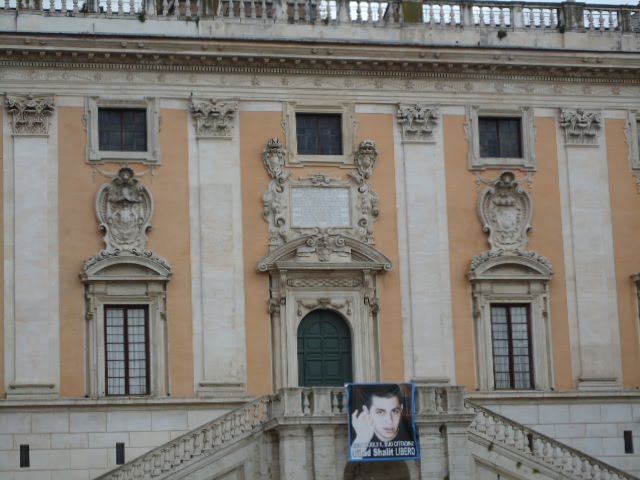
I will let it go with the tidbit that these buildings show Michelangelo's study of ancient art and architecture very clearly, as they have for the first time since the buildings of antiquity, a double order pilaster: columns which are 2 stories high, providing unifying vertical lines to the facades, and making a very grand impression indeed.
The collection includes two Caravaggios, but John the Baptist is on loan to the exhibition at the Scuderie Quirinale, leaving only The Fortune Teller in the Pinacoteca Capitolina. Having visited the Capitoline  Museums before, I knew what to expect, so let me warn the reader: there are 3 buildings chock full of fabulous Roman antiquities, interconnected by tunnels which offer some of the best views possible of the Roman Forum. On a mission to study Caravaggio, however, for this trip, I skipped over everything in the ancient collections except Dying Gaul, an old friend I had to visit, and went straight through the tunnel to the Pinacoteca, where the paintings are.
 Museums before, I knew what to expect, so let me warn the reader: there are 3 buildings chock full of fabulous Roman antiquities, interconnected by tunnels which offer some of the best views possible of the Roman Forum. On a mission to study Caravaggio, however, for this trip, I skipped over everything in the ancient collections except Dying Gaul, an old friend I had to visit, and went straight through the tunnel to the Pinacoteca, where the paintings are.
The Fortune Teller is supposed to be  about the gypsy woman stealing the ring off the unsuspecting gentleman's hand, but for the life of me, I didn't see any semblance of a ring in either hand, and I looked. Perhaps she is simply telling his fortune. This is another light hearted genre scene like the Cardsharps in the exhibition at the Scuderie Quirinale (from the Kimbell Museum in Ft. Worth). The obvious rip-off in that canvas does give credence to the theory that this fortune teller is in fact stealing the ring, but I didn't see it, try as I might. You try.
 about the gypsy woman stealing the ring off the unsuspecting gentleman's hand, but for the life of me, I didn't see any semblance of a ring in either hand, and I looked. Perhaps she is simply telling his fortune. This is another light hearted genre scene like the Cardsharps in the exhibition at the Scuderie Quirinale (from the Kimbell Museum in Ft. Worth). The obvious rip-off in that canvas does give credence to the theory that this fortune teller is in fact stealing the ring, but I didn't see it, try as I might. You try.
That completes Day 2 of my Caravaggio in Rome Tour. If you were able to complete it, I congratulate you because there are MANY distractions along the way which are delightful in themselves, but you have kept your focus and studied over half of Caravaggio's entire life's work in two days. Your feet must be killing you. Time to slip on those new Pope socks, have a glass of vino tinto and put those puppies up. Room Service?


